Let’s cut to the chase—if you’re in industrial processing, HVAC, or any application where temperature control isn’t a nice-to-have but a must-have, you’ve probably wondered why your thermocouple reads a temperature 5, 10, or even 20 seconds after a change happens. That delay, my friend, is the thermocouple response time, and it’s not a random flaw—it’s a measurable, make-or-break spec that separates a smooth operation from a costly shutdown. As someone who’s spent 12 years selling thermocouples (and troubleshooting hundreds of misapplied ones for clients across mining, food and beverage, and petrochemical plants), I’ve lost count of how many times a client blamed their “faulty thermocouple” when all they needed was a better understanding of response time. Let’s break this down simply, no jargon that’ll make your eyes cross, and plenty of real-world examples you can take to your team. Thermocouple

First, let’s get the basic definition straight. Thermocouple response time is the amount of time it takes for the sensor’s junction (the two wires of dissimilar metals twisted, welded, or fused together) to register 63.2% of a sudden temperature change. That’s the industry standard set by ASTM, not some arbitrary number I pulled out of thin air. Why 63.2%? It’s tied to the mathematical behavior of heat transfer, specifically the time constant—this is the core metric, even if you’ll often hear “response time” used interchangeably with the time constant. For most practical purposes, if your thermocouple has a 2-second time constant, it’ll reach 95% of the new temperature in about 10 seconds (that’s 5 time constants, a rule of thumb anyone in process control should memorize).
Here’s where the confusion starts: response time isn’t a single number that works for every scenario. I once had a food and beverage plant client call me in a panic because their new thermocouples were taking too long to trigger a batch pasteurization alarm. They told me they were using the same type they’d bought from another supplier for years, same size, same model—until I asked where they were installing the probe. Turned out, their old supplier was selling them standard grounded-junction thermocouples, while the new ones they’d sourced mid-year were ungrounded. Grounded junctions (where the metal junction is welded directly to the thermowell) have a much faster response time, usually 0.5 to 5 seconds for a 1/8-inch probe, because there’s no air gap between the junction and the metal it’s mounted on. Ungrounded junctions, by contrast, isolate the wires from the thermowell, which cuts down on electrical noise (great for static-heavy environments) but adds that air gap, slowing response to 2 to 20 seconds. That’s the difference between a batch that’s properly pasteurized and one that’s underprocessed—no wonder they were stressed.
Let’s talk about the biggest factors that tweak a thermocouple’s response time, because this is where 90% of misapplications happen. First, probe size and junction type. Thin-gauge thermocouple wires (like 0.010-inch) have far faster response times than 1/4-inch heavy-gauge wires—think 0.1 seconds vs. 10 seconds, respectively. But there’s a catch: thin wires wear out faster, especially in abrasive or corrosive environments, so you can’t just swap in the thinnest option without checking how it’ll hold up to your process. Junction type: as I mentioned earlier, grounded is fastest, then exposed (where the junction is sticking out from the thermowell, common in gas flow applications), then ungrounded is slowest. I always tell clients to pick grounded unless their process has serious electrical noise issues—we can offer options like grounded with shielded cables to cut noise without sacrificing speed.
Second, the thermowell itself. This is the metal tube that protects the thermocouple from steam, chemicals, moving parts, or physical damage. A lot of first-time buyers don’t realize that the thermowell is a huge bottleneck for response time. A thick, 316 stainless steel thermowell with a long insertion depth will insulate the junction from the actual process temperature, adding 5 to 10 seconds of delay. A thin-walled thermowell, or a bare probe (no thermowell at all, for applications where exposure is safe), eliminates that extra lag. I had a petrochemical client a few years back who was using a 6-inch thick thermowell in a high-speed gas line. Their temperature readings were always 15 degrees low, and the alarm would trigger late during a pressure spike. We swapped their thermowell for a 2-inch thin-walled version, and their response time dropped from 12 seconds to 2 seconds—fixing their overpressure alerts immediately.
Third, the process itself. It’s not just the thermocouple—it’s what you’re measuring. A thermocouple in moving air (like a duct for HVAC) will respond much faster than one in still water, because heat transfers faster through moving fluids. For example, a thermocouple with a 2-second time constant in still water might take 10 seconds to read a change, but in a 10 ft/s air flow, that same probe can do it in 1.5 seconds. I once had a mining client who was measuring ore slurry temperature in a slow-moving tank—their response time was 15 seconds, and they thought their thermocouple was bad until we realized the slurry was moving at less than 1 ft/s. We switched them to an exposed junction probe instead of a grounded one, and even though the slurry was slow, the exposed junction was directly touching the slurry, cutting that delay to 7 seconds.
Now, let’s get to the specs you’ll actually see on a thermocouple data sheet. You’ll almost never see “response time” listed as a single number—instead, you’ll see the time constant, often labeled as τ (tau), measured under a specific test condition (usually moving air or still water, at a specific pressure). That’s why it’s critical to check not just the number, but the test conditions. A supplier who lists a 1-second time constant without saying if it’s in moving air is giving you incomplete data. At our company, we always list time constants with two conditions: one for gas flow (10 ft/s) and one for liquid flow (1 ft/s), so you know exactly what you’re getting. We also note junction type and probe size, so you don’t have to dig for the details.
Let’s also address a common myth: faster response time is always better. It’s not. If you’re measuring oven temperature where the process is slow and stable, a fast thermocouple might trigger unnecessary alarms from small, random temperature fluctuations. But if you’re measuring dynamic processes—like a plastic extruder where the melt temperature changes every second, or a pasteurization line where you need to hit a precise temperature to kill bacteria—faster response is non-negotiable. I had a food processing client who wanted the fastest thermocouples we made for their chocolate tempering line. They were using a slow probe that missed a 2-degree temperature spike, ruining a batch of 500 pounds of chocolate, which cost them $1,200 in scrap alone. Swapping to a 0.5-second time constant probe meant they caught every tiny temperature shift, and that mistake never happened again.
Another thing that affects response time: cable length and type. Wait, I know what you’re thinking—cable length? How does that matter? It’s not the length itself, but the resistance of the cable. If you have a very long cable (over 100 feet) with low-gauge wire, it can add a small amount of lag as the electrical signal travels from the junction to the transmitter. That’s why we recommend using shielded, high-gauge thermocouple extension cables for runs over 50 feet, to minimize that delay. I’ve seen clients with 200-foot cable runs using standard 20-gauge wire, adding 2-3 seconds of lag—something they never would have noticed until they switched to the right cable.
Now, let’s talk about how to calculate if your thermocouple’s response time is right for your application. Let’s say you have a process where you need to respond to a temperature change in 5 seconds or less. First, find out your required time constant: a 5-second response time (to 95% of the change) means you need a time constant of about 1 second (since 5 time constants equal ~95% of the change). Then, factor in your process conditions: if you’re measuring in moving liquid, that 1-second time constant will work, but if it’s still gas, you might need to bump it up to 2 seconds. If you’re not sure, send us your process details—we’ve helped hundreds of clients pick the right thermocouple for their needs, and we don’t just sell you whatever’s the cheapest.
I can’t end this without addressing the times when response time is a problem that isn’t the thermocouple’s fault. A lot of times, a slow reading is actually a transmitter issue, not the probe. If your transmitter is old, it might have a slow update rate, meaning it only reads the thermocouple’s signal every 5 seconds, adding that delay on top of the probe’s response time. So before you write off your thermocouple, check your control system’s update rate. That’s a common mistake I see all the time—clients blame the sensor, when it’s just the display or transmitter lagging.
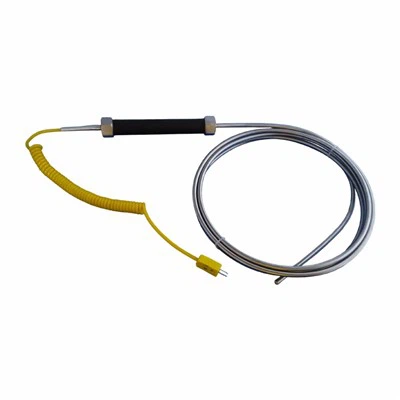
At the end of the day, thermocouple response time isn’t a spec to ignore. It’s the difference between a safe process, a high-quality product, and a costly mistake. Whether you’re in food and beverage, petrochemical, HVAC, mining, or any industry that relies on temperature measurement, getting this right saves you money, time, and stress. If you’re tired of your thermocouple reading temperatures too late, or if you need help picking the right probe for your dynamic process, reach out to us to discuss your requirements. We can help you calculate the perfect response time for your application, no hidden specs, no confusing jargon, just honest advice from a team that’s been in the thermocouple business for years.
Digital Temperature Controller References
- ASTM International. (2019). Standard Test Method for Time Response of Thermocouples and Resistance Temperature Devices. ASTM E644-19.
- Gardner, J. W. (2001). Transducers and Sensors: A Practical Guide to Performance, Selection, and Design. CRC Press.
- Li, Y., et al. (2020). Heat Transfer Effects on Thermocouple Response in Process Industry Applications. Journal of Process Control, vol. 92, pp. 112-121.
Jiangsu Zhaolong Electric Co., Ltd.
We’re well-known as one of the leading thermocouple manufacturers and suppliers in China, featured by quality products and low price. Please feel free to buy customized thermocouple made in China here from our factory. Contact us for more details.
Address: No. 80, Zhangguo Chang’an Road, Dainan Town, Xinghua City, Jiangsu Province
E-mail: 180193845@qq.com
WebSite: https://www.cnzhaolong.com/
